

Grief and Dinosaurs
Understanding political opposition to Sam Neill's passing

Sir Sam Neill was an absolute legend. His death this week was a shock. And for some people it forced them to face an internal reckoning - gone was an actor they felt connected to in some way. But for some, the actors views did not match theirs and that is not always an easy thing to reconcile.
Neill was a vocal supporter of Dame Jacinda Ardern and a vocal opponent of the Coalition’s populist rhetoric, it’s plans for fast tracking projects and especially the proposed Mine to be set up in his beloved central Otago. And to be fair, if they did something he agreed with, he also said so - like National’s plan to deal with wildling pines. There is a long history of his opposition to authoritarianism, to the actions of right wing governments and his concerns about media manipulation - a lot of it born from his time working in the US and referencing American media like Fox news.
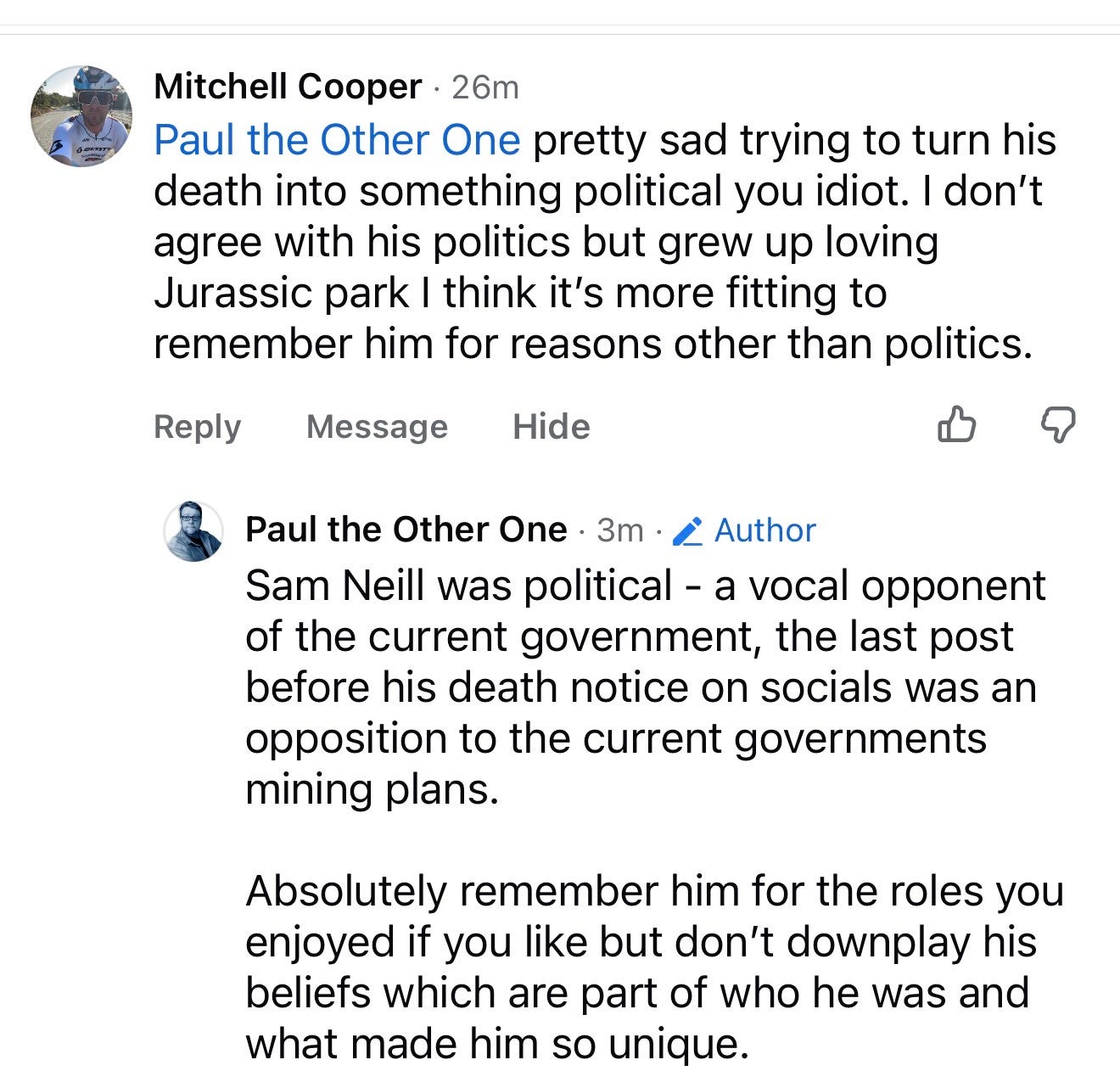
Some of the people leaving comments demanding an avoidance of politics around content on his passing were clearly right wing in their beliefs - feeds full of NZ CPR, Tax Payer Union, pro-Trump content with posts from all three coalition parties. None I saw came from people with beliefs they shared with Neill - and this fascinated me because it feels like cognitive dissonance in action - where the brain doesn’t know how to reconcile two truths - in this case, an Actor they felt connected with had passed and someone they connected with had such diametrically opposed views to them.
So I reached out to a psychologist I know to do some digging. She agreed to answer my questions but only if I agreed to keep her details off the record so it didn’t impact her current or future client work - which seems fair.

She told me that this has the hallmarks of cognitive dissonance in action because claims like “saying Sam Neill didn’t like the current coalition government” was seen as being negative to them. It’s an attempt to selectively strip away the elements causing that disconnect and leave only a sanitised version of them. But there’s also a media element here when someone famous dies - their death amplifies their message as media covers them and this makes it worse for those dealing with this disconnect. Demanding a sanitisation of their views allows them to better take part in a collective grieving moment.
She also pointed out to me that there’s sociological phenomenon where some people make a sort of deal to justify their experience - basically “I’ll watch your films and enjoy them but they’re entertainment and not an agent for political discussion” and bringing up anything that breaches that contract for them can cause them to be upset - in this case noting Neill was incredibly proud of his roles that gave voices to people who felt should be heard more, like his work in The Piano which he saw as a icon of feminist film making. A choice that was political for him and others but presented as simply entertainment to some.
And there were a number of roles Neill had which had meaning that audiences might not realise. His roll as Chester Campbell in Peaky Blinders is a dark critique of British Imperial rule and systemic corruption that subverts traditional hero-villain dynamics to explore corrupt morality tied into the real world Northern Irish troubles played by a man who had migrated from Ireland as a child to another country grappling with colonisation in different ways.
It was also pointed out that without knowing the specifics of each individual it’s impossible to say for sure that what we’re dealing with is specifically grief induced cognitive dissonance.
So I decided to explore a different angle - who was most likely to experience this.
Turns out there is a heap of research on personal ideological views and the impacts they have on cognitive closure. Conservatives, according to research in 2013, are more highly motivated to actively avoid dissonance causing situations. Because conservatives tend to have a lower tolerance for this type of psychological conflict, they’re more likely to deploy defences to demand people stop making them feel that way.
There’s also issues with rapid change - conservatives do not like rapid change unless the believe it profits them directly. This is known as System Justification Theory and since their world view is more about retaining the status quo, a sudden change like a high profile death can challenge that. And along those lines, Conservatives tend to process information in a more linear fashion, focusing on clear lines of definition and a complex public figure who makes dinosaurs look good while dealing with a torrent of hate from political trolls for not wanting an open cast mine in his back yard, that can cause a bit of a short circuit to happen.

So basically - it’s really complicated but some people don’t like to be reminded that an actor they enjoyed didn’t share their world view. And I noticed that during all this research and talking to experts on the topic that I was being driven by my dissonance of not understanding how some people could want to seperate an Actors roles from their world view when they passed.
It turns out that no matter where on the political spectrum we sit, we are all triggered by being exposed to other peoples view points when they’re in opposition to our own.
The research shows liberals tend to build their moral compass around ideals of avoiding harming others while caring for others and avoiding cheating while believing in over all fairness. And when something shocks us, like a celebrity death where we feel a sudden disconnect because our beliefs don’t match, we tend to disassociate quickly, and move on quickly so we don’t feel complicit in the thing about them we did not like. That same research shows liberals tend to have a low tolerance for people who lie, cheat, cause harm and lie about it - which might go some way to explaining why the hard right on social media will make snide remarks about issues or people that are long gone while the left get angry about injustices they feel were never properly dealt with.
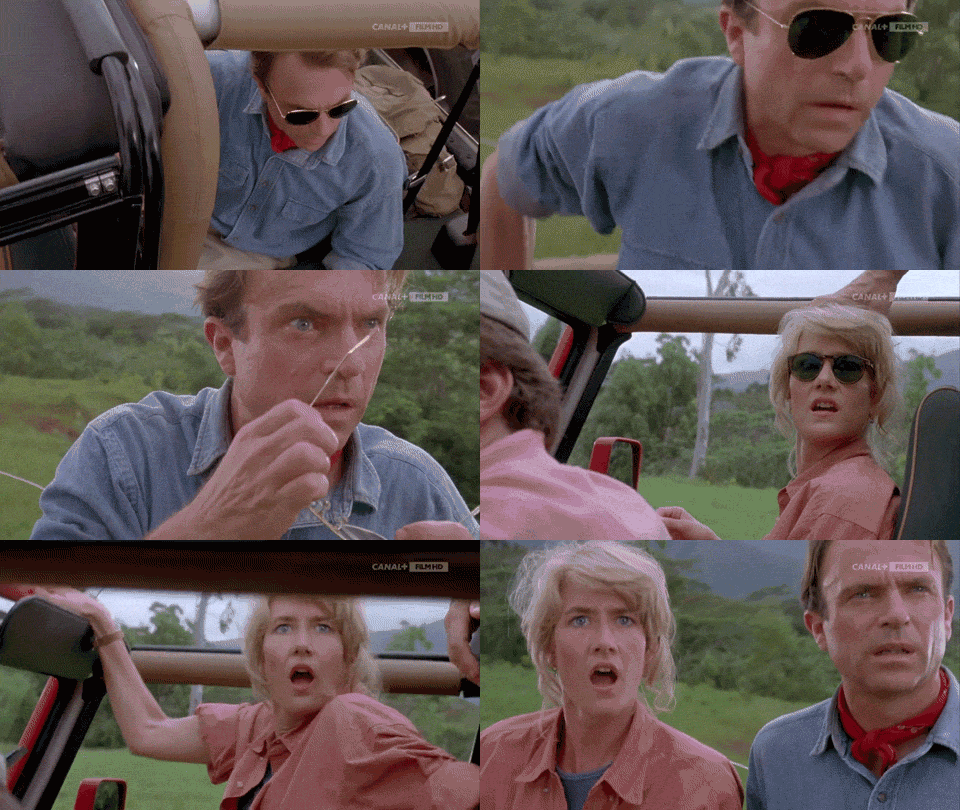
Ultimately we all grieve - and it doesn’t matter if you’re politically liberal, conservative or somewhere else across the political spectrum, grief impacts us all and with a shared cultural world of touchpoints that we share common understanding over, is suddenly take away from us, we all have to reckon with our own feelings. That shared experience of seeing Dinosaurs come to life for generations, that moment when we watch Alan Grant take off his glasses and stare across the island as they roamed in herds - the DO roam in herds, it shows that we often share more than we realise with people who probably don’t all see the world the same way. And it should remind us that demanding we leave politics out of someones lived experience is missing the point of a lived life. Maybe the best way we can pay tribute to a man who clearly had such an impact on so many (me included, I did a whole psychological deep dive newsletter spewing my train of thought and research just because he was gone and I realised I’d lost a chance to ever sit down and talk to him after all - so I’m sorry about that) is to learn to be as uncomfortable in their departure as Alan Grant was around children together.
Sam's was truly a lived life and it would be ridiculous to try to separate the actor from the man who stood up so bravely and so politically for the causes he believed in.