

Who Controls Your Voice
The Conservatives Behind So Much of our MSM

In 2026, the landscape of Aotearoa New Zealand’s “Fourth Estate” is facing a critical juncture. The convergence of political-to-media board appointments, Australian private equity dominance, a gradual “creeping bias” and a razor thin line of what constitutes editorial interference in state media, has created a structural alignment that could undermine the media’s role as a democratic watchdog during an election year with some pretty major consequences on the line.
So I wanted to take a high level look at some of the stalwarts of our local media landscape, and how they’re being reshaped to give prominence to specific political views and biases.
To know which media outlets have the most influence we can look at the numbers.
Research released by Roy Morgan last year showed that the Herald had the most viewers across platforms (so physical papers, online, video), but online only audiences, Stuff had the largest audience share, followed by TVNZ, then the Herald. Newstalk ZB is the most listened to radio station in the country, claiming close to 300’000 listeners daily. Hosking is still the top rated radio presenter in the country - and it’s the most popular media outlet generally for senior citizen audiences who are also the most likely to vote, the least likely to have the media literacy skills to recognise the difference between news and opinion and the most likely to be part of the groups targeted by conservative political parties (home owners, white, own investment portfolios)
So NZME owns The Herald, Herald on Sunday, Business Desk, Bay of Plenty Times, Rotorua Daily Post, Hawkes Bay Today, Northern Advocate, Whanganui Chronicle, and Gisborne Herald in print, Newstalk ZB, ZM, The Hits, Coast, Radio Hauraki, Flava, Gold, Sport and Hokonui on radio and titles like OneRoof for property sales, iHeartRadio for podcasts, Driven for cars and Canvas Magazine. That is a huge amount of influence - and while radio sport is not likely to be used to push political views, there is a lot of reach and influence there - so the NZME governance board is a powerful group in setting media agendas for the country - they set strategy, determine funding priorities, and “acceptable” parameters of editorial debate.
In June 2025, Steven Joyce, a former senior Cabinet Minister, five-time campaign chair for the National Party and the subject of many Dildo Baggins jokes and a John Oliver ribbing for his sex toy-to-a-face incident, was appointed as the Independent Chair of the NZME Board.
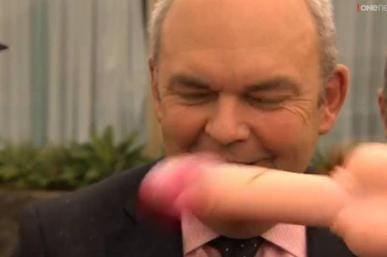
Joyce does have actual media experience, as the founder of MediaWorks. He’s also an independent director on Winton Land, the Fast Track bidder that wanted to circumvent local authorities to build on flood prone land in Queenstown, and forced Chris Bishop to step out of the fast track process involving them since he had advocated for their project and it was a conflict of interest. Oh and he took home a nice million dollar pay cheque for working with the University of Waikato to lobby the National led government for their new medical school.
Joyce’s leadership has coincided with a push for “efficiency,” resulting in the loss of 30 newsroom roles at the Herald and BusinessDesk in 2025. By prioritising commercial dividends and high-engagement content, boards can indirectly steer editorial focus toward business-friendly narratives while deprioritising costly investigative journalism.
Then there’s Canadian billionaire Jim Grenon who also joined the board in 2025 after a public battle for control. Grenon has advocated for, and won “editorial advisory boards” to oversee news operations. Grenon has also used in his money in the past to platform and empower spreaders of disinformation, through his own platform The Centrist (which was anything but), as well as directly funding known disinformation spreader Chantelle Baker and recently paying for the defence of Julian Batchelor in a defamation lawsuit against TVNZ and disinformation researcher Dr Sanjana Hattotawa. His self described reason for founding the Centrist and his interest in the NZME stable is to “challenge mainstream media’s bias” while vilifying DEI, tax reform, the WEF, 3 Waters Reform, co-governance and climate change. He’s a fan of the Atlas connected Free Speech Union - and was reported to be interested in the Herald because of their refusal to print advertisements from Hobsons Pledge, Voices for Freedom and Family First which was, according to him, a bad thing.
The combination of a former National Party strategist and a libertarian billionaire at the helm signals a push toward an even more libertarian or right-leaning commercial strategy and has seen a number of concerns raised publicly about a shift in content presentation and focus - although, to be fair, Mike Hosking and the majority of Newstalk hosts have long been right wing cheerleaders after all Newstalk is the definition of a right wing echo chamber.
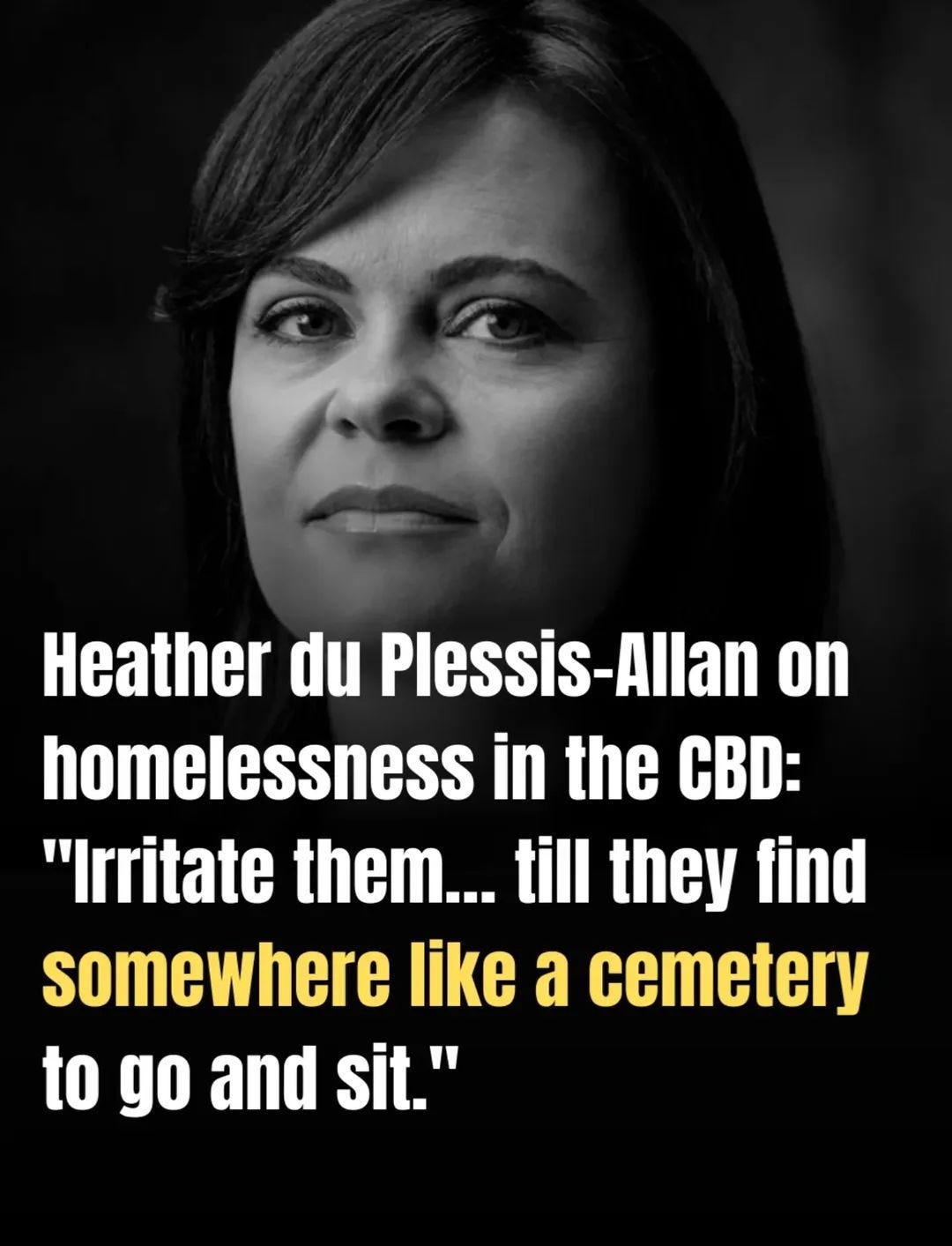
But that board choose who is in charge of Grenon’s Editorial Advisory Board - this week they announced Christopher Luxon’s former Press Secretary and current corporate PR and lobbyist person, Hamish Rutherford was taking over as chair of that board. Other members of the board include conservative lawyer and commentator Philip Crump (Who Grenon wanted on the board when he tried to take over) and Brent Webling - former researcher for John Key, Don Brash and Bill English who was hired by TVNZ to not be a lobbyist, just someone who talks to government officials about the narrative TVNZ wanted them to share, according to former TVNZ Board Chair, Simon Power.
But NZME Is ultimately a private enterprise - it’s editorial style and guidance are down to the people who own it - so what about our public media? Under NZ law, funding is given to both RNZ and TVNZ for news services while also putting in place legal restrictions on an MPs ability to interfere or threaten the outlets to avoid media bias or manipulation. So when Winston threatens funding, he knows he’s pushing the envelope and when Nicola Willis then cuts their funding, they should know that looks like a threat being carried out.
But there are other ways the government influences these outlets - by using the power of an appointment. Last year they put Andrew Barclay in as Chair of the TVNZ Board - Barclay is a former Goldman Sachs chief who replaced Alastair Carruthers who resigned from the board early in his tenure in the role for reasons that have never been made public but media at the time inferred was down to ideological differences between the government and his view of the role. Barclay’s appointment came with an edict from Broadcasting Minister Paul Goldsmith to make the organisation more commercially focused. Barclay was revealed to have called Minister Goldsmith to discuss how 1News coverage showing negative impacts of government policy made and seemingly apologise before 1News soon did news stories that followed the government’s exact narrative.
They also put Broadcaster and known outspoken right wing populist Paul Henry on the Board.
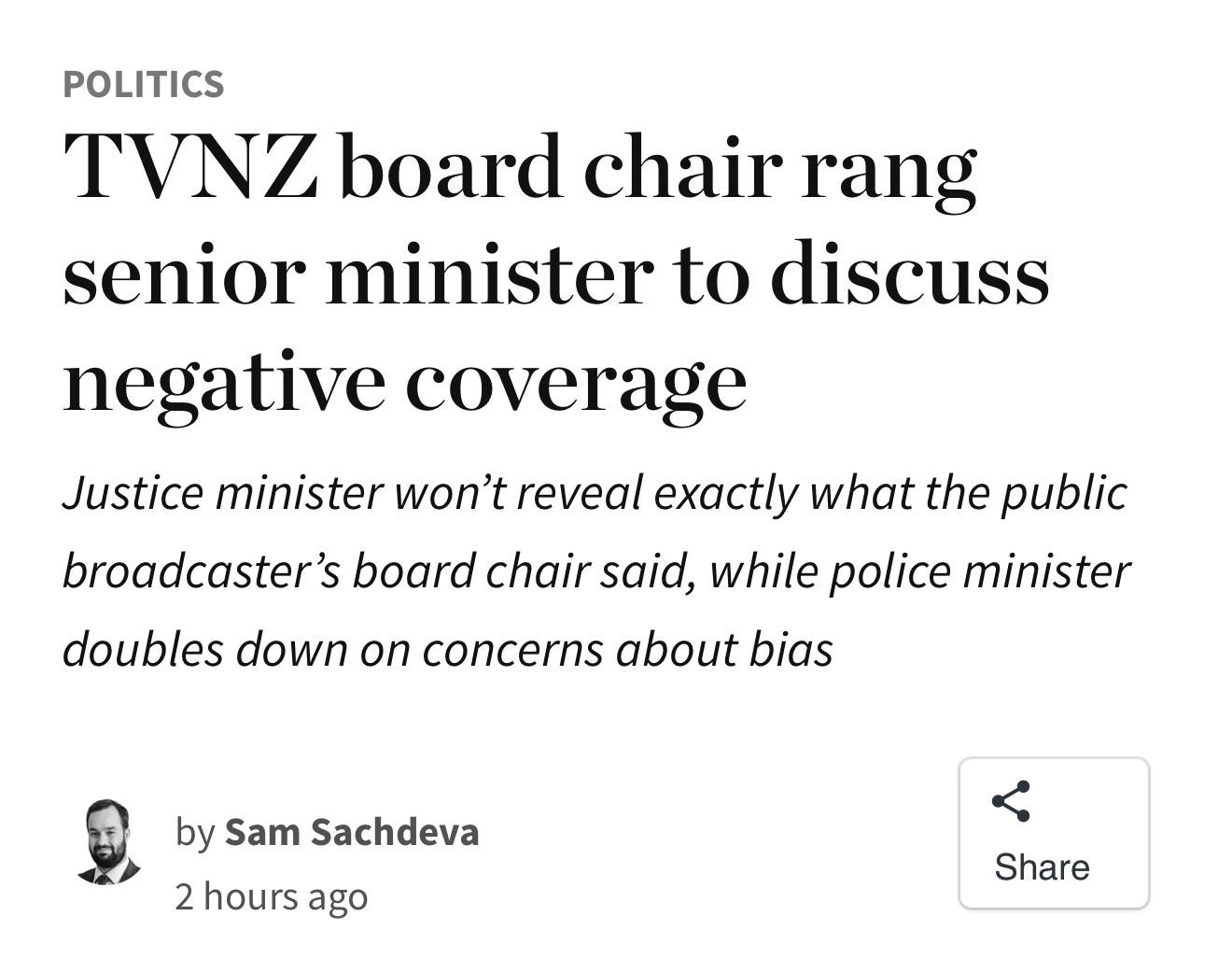
And Goldsmith has been really clear - TVNZ needs to look at a user-pays philosophy, mirroring the models we see in other countries that result in less media output, less work for the screen sector, and less ability to fund news media that holds governments to account. Slightly more articulate than “grunts” he claimed he made when caled by Barclay to discuss unfavourable media coverage a day before much more favourable coverage on the same topic in what feels like clear ass kissing,
While local politicians set the “vibe,” often Australian often capital provides the “fuel.” MediaWorks, that media outlet founded by Dildo Baggins, is now fully owned by Quadrant Private Capital, an Australian private equity firm.
Generally, private equity models prioritise short-term ROI, and can lead to abrupt changes - like the sudden closure of Today FM in 2023, and serious restructuring and job losses in 2024 across MediaWorks channels.
A significant challenge in identifying these shifts is their incremental nature. Unlike a sudden government takeover, media capture in New Zealand happens through “creeping bias”—a series of small, board-level decisions that slowly alter the editorial ecosystem.
These shifts manifest as a slow attrition of resources. It starts with the closure of a regional news office, followed by the replacement of a hard-news slot with a “lifestyle” or “opinion” segment. Over time, the range of ideas tolerated in public discourse drifts, making once-fringe corporate or political views seem like the “common sense” centre - and it just takes a quick look at the comment sections of media outlets to see the impact this can have.
And these all have some pretty big outcomes we need to be concerned about - they erode public trust in media which leads to a lot of the clear polarisation we see in many spaces these days. There’s a lack of accountability as funding ends up for quick clickbait and pulled from more resource intensive deep dives and investigations, and it all fuels the increase of news deserts, where people feel like there is nothing speaking to them which drives audiences to alternative media like The Platform and Reality Check Radio - which are both outlets that argue they should not be regulated to the same standards we expect from other media which means an increased ability to deliberately mislead people, and grift from them.

And through a lot of media ownership models is a really fascinating connection - the power of Real Estate. OneRoof for example is one of the most profitable arms of NZME, and was used as the justification for why Grenon tried to buy all of Stuff’s South Island titles and the reason behind Trade Me’s eventual successful bid for 50% of Stuff Digital. Since 2021, the Property industry has been the single top donor industry, putting over $2.5 Million into the campaign war chests of Act, National and New Zealand First for the 2023 election. The industry that sees the current coalition as in their pocket is also the largest advertiser in media.
So it’s in the best interests of all those involved - the media owners, the media regulators, the media funders to keep the status quo model - which means pushing for a retention of the current government.
The trend in 2026 seems clear: the “Fourth Estate” is being managed more like a commercial subsidiary of the political-industrial complex. By placing campaign veterans, populist broadcasters, and private equity managers in governance roles, the “policy” of New Zealand media is being steered toward fiscal conservatism and a reduction in the “activist” role of the press.
A healthy democracy requires a media that is not only editorially independent but structurally robust enough to challenge the very interests that fund it. We need media that asks questions like “why should we trust the TPU as a watchdog on spending when they refuse to open their books to be held to the same account” or “Why do mega landlords get to set policy on housing and landlords”.
Without this, Aotearoa risks losing the transparent information flow necessary for a functioning society.Ironically, they end up with the media machinations they claimed were there under the previous government and the creation of the Public Interest Journalism Fund during lockdowns at the height of the pandemic, despite actual processes in place to ensure that didn’t happen.